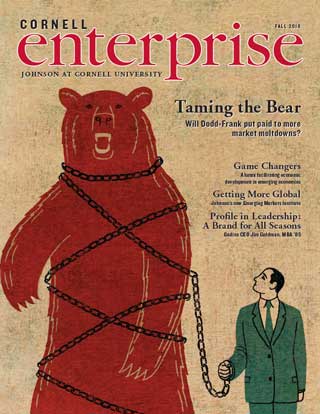
FALL 2009
  • Features
  • |
  • Web Extras
  • |
  • Inside Johnson
  • |
  • Departments
ThoughtLeadership@Johnson
Finding Values in Frozen Markets

In an award-winning paper, Maureen O’Hara and Cornell colleague David Easley explain what happened in the financial crisis and describe how to value assets even when trading stops.


By Robert Preer

A striking and ominous feature of the financial crisis of 2007 to 2009 was the freezing of markets. First to shut down were markets for complex instruments, such as mortgage-backed securities and collateralized debt obligations. Then, illiquidity spread with alarming speed to everything from commercial paper, to money markets, to almost every other credit market.

“Markets for auction rate securities—which are viewed as almost perfect substitutes for U.S. Treasury securities—froze,” says Maureen O’Hara, the Robert W. Purcell Professor of Management and professor of finance at the Johnson School. “For the most part, housing froze. You couldn’t sell a house in Detroit or Phoenix.”

O’Hara and David Easley, the Henry Scarborough Professor of Social Sciences in Cornell’s Department of Economics, developed a model that explains what was behind the recent market seizures. They went on to outline an accounting strategy that permits the valuation of assets, even when markets have effectively ceased to function.

Their model and conclusions are published in “Liquidity and Valuation in an Uncertain World,” which recently won the Western Finance Association’s prestigious award for best paper in asset pricing.

In crafting their model, Easley and O’Hara, draw on the insights of early 20th century economist Frank Knight, whose 1916 economics doctoral dissertation at Cornell highlighted the importance of uncertainty in economics. Knight’s influential work, later published as the widely read book, Risk, Uncertainty and Profit, drew a sharp distinction between risk, which typically can be calculated, and uncertainty, which has unknowable probabilities.

Why Markets Froze

In the financial crisis, market participants were unable to calculate the risks they faced, according to O’Hara and Easley. The turmoil in markets was so great that participants were unable to attach probability estimates to possible outcomes. Thus investors faced both risk and uncertainty as to future outcomes.

“What we discovered in the recent market events is that when people can’t figure out what to do — when they don’t know whether to buy or to sell — it causes them to freeze,” O’Hara says.

The financial crisis also has presented a challenge to the economics discipline. Economic analysis has long assumed that individuals can weigh risks in the marketplace and assign an optimum price for an asset. Below that price, an individual is a buyer; above it, a seller. But during the financial crisis, these assumptions appeared to no longer hold. Traders could not identify optimum prices. Bid and ask prices existed, but no trades took place.

“There’s no perfect price in a world in which there is no trading. What you are looking for is the best estimate of this true price. Our model suggests that when uncertainty is high, this best estimate is the midpoint.”
— Maureen O’Hara, Robert W. Purcell Professor of Management and professor of finance

“You didn’t know whether you should buy more of it or whether you should be selling it,” says O’Hara. “You were just stuck.” The mathematical model developed by Easley and O’Hara depicts how trade takes place in an economy and how traders make decisions when faced with such uncertainty. To capture what happened during the financial crisis, the researchers introduced a “shock” in the form of a dramatic drop in the expected future value of assets. In this scenario, traders could not determine the magnitude of the decline, and so could not come up with preferences for their portfolios. Models of incomplete preferences are not standard in economics, but as the authors demonstrate, such models provide very useful insights into how markets behave in uncertain times. Under these conditions, there is a range of bid and ask prices for assets, but no price exists at which supply and demand intersect. Trading comes to a halt.

“Equilibrium in this uncertain economy is thus characterized by a range of prices, and trades occur at none of them,” the authors write. “In effect, while nominal bid and ask prices can be calculated, the economy is in fact illiquid, with buyers and sellers unwilling to trade.”

Valuing Assets when Trading Stops

But even when markets are frozen, values still must be attached to assets. The Financial Accounting Standards Board, a private agency relied on by the U.S. Securities and Exchange Commission, requires firms to assign prices to assets to ensure transparency and to allow investors, creditors, auditors, and others to evaluate assets and to make financial decisions.

One solution, recommended by the FASB, is to use the bid price to set asset values in markets where trading has ceased. Easley and O’Hara argue against this approach.

“In a world where these spreads have become extraordinarily large, reflecting the uncertainty out there, the bid price is really not a good estimate and typically will be biased downward,” O’Hara says.

Similarly, the ask price is not a good measure. “The ask price is set by the least optimistic trader about the best possible outcome,” the authors write in the paper. “Again, when uncertainty is large, there is no trade occurring at this price either.”

Applying statistical and theoretical analyses, O’Hara and Easley conclude that the most accurate valuation comes by taking the midpoint of bid and ask prices. In situations where trading has ceased and the precise value is simply unknown, “it seems reasonable to suppose that on average, the decline in the value of the asset is the simple average of the best and worst possible cases,” the authors write.

O’Hara stresses that using the mid-point between bid and ask prices does not guarantee accuracy, but she argues the approach is the best way to reduce errors, which are more likely to occur if points on the extremes are used. “The way to look at it is that there’s no perfect price in a world in which there is no trading. What you are looking for is the best estimate of this true price. Our model suggests that when uncertainty is high, this best estimate is the midpoint,” O’Hara says.

The New Model and Economic Principles

O’Hara and Easley have long been interested in uncertainty and risk. They were preparing their award-winning paper when the financial crisis hit. “This was written as we watched things happen that we didn’t think could be explained by existing models,” O’Hara says. “The approach that we were developing definitely seemed to make sense. The problem of markets freezing obviously was not something well covered in standard economics.”

Yet rather than disavowing basic principles of economics — such as the assumptions that individuals are rational and that they maximize utility — the new model “allows for the problem that people sometimes do not have the information or the ability to calculate possible outcomes,” O’Hara says.


Bookmark and Share
  • Features
  • |
  • Web Extras
  • |
  • Inside Johnson
  • |
  • Departments
ThoughtLeadership@Johnson is a quarterly e-newsletter and multimedia Web site that highlights Johnson School faculty research and draws on their expertise.


Rss feedSubscribe to the comments for this page

Comments (1)
Posted by Roger O'Daniel (1959) on January 4, 2010:

Last fall, I was a panelist about small business reactions to the economic recession. When the conversation got around to economics, I offered two "economic theories" for consideration. I called the first one the "bigger fool" theory. If one invests in things like collectables, art, and lake property, they must find a bigger fool than they were to sell it. The second one was the "rational expectations" theory. Influential people will size-up the situation as it affects their company and/or them personally. They will try to predict the consequences, and behave according to their rational expectations. If the collective judgment of a lot of these people is the same, the rational expectation becomes a self-fulfilling prophesy.

Post a new comment:

Name:

Email:

Comment:


  • Johnson School Home
  • |
  • Alumni Home
  • |
  • About Enterprise Online
  • |
  • Contact
© 2009 The Johnson School