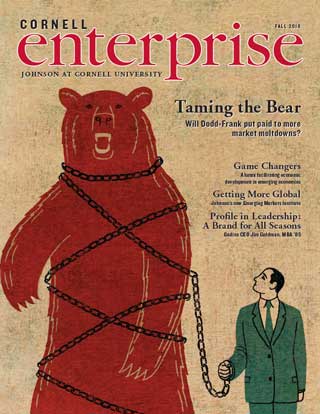
Taming the Bear
Will Dodd-Frank put paid to more market meltdowns?
When President Barack Obama signed the Dodd-Frank bill on July 21, he declared that the financial regulatory reform law would empower consumers and investors, shine a light on shadowy deals, and end taxpayer bailouts.
“It provides certainty to everybody, from bankers to farmers to business owners to consumers,” he added.
Whether the law will cure the ills that caused the global financial
crisis is a matter of much debate. But experts at Johnson agree on
one point: Financial reform has not brought much certainty.
"We’re going to have interpretations and enabling legislation and regulations for the next three-and-a-half years. Dodd-Frank hasn’t reduced uncertainty; it has increased uncertainty."
— Professor Robert J. Swieringa
“Every financial company, every professional trade association, every law firm, every accounting firm, every consulting firm is spending their time studying this bill,” Accounting Professor Robert J. Swieringa says. “We’re going to have interpretations and enabling legislation and regulations for the next three-and-a-half years. It hasn’t reduced uncertainty; it has increased uncertainty.”
The new law deals with almost every aspect of the financial system, from derivatives to executive pay to credit-rating agencies to consumer protection to hedge funds. But in many areas, the legislation omits specific rules, which are left to regulators to craft.
“The bill is open-ended. It legislates the need to do certain things and leaves the details to various government entities to deal with a later date,” Professor of Finance and Economics Robert A. Jarrow says. “I’m not a political scientist, but that seems rather unusual to me — Congress adopts a framework but leaves many of the details to officials who are appointed and not elected.”
George Andrew Karolyi, professor of finance and global business, says enactment of the bill, while an important milestone, mainly sets the stage for decisions about specific regulations, as well the design of new agencies the law creates. He notes that the controversy surrounding establishment of the Bureau of Consumer Financial Protection is a preview of things to come under the law. “When I talk about this bill I have a simple theme,” Karolyi says: “’Ladies and gentlemen, please don’t think this is the end of anything. It’s the beginning of everything.’”
A crisis reaction
The Dodd-Frank Wall Street Reform and Consumer Protection Act is the U.S. government’s response to the financial crisis, which in 2008 brought the world financial system to the brink of collapse. Stock markets plunged, businesses failed, wealth evaporated, and millions lost their jobs and homes. President Obama called for an overhaul of the financial system, and after months of debate, maneuvering, and compromise, both houses of Congress and the president settled on this bill.
“The legislation really is a collection of many remedies to all of the different aspects of the financial crisis,” Associate Professor of Finance Yaniv Grinstein says.
The crisis began with the bursting of the U.S. housing bubble, which arose because brokers sold mortgages to buyers who couldn’t repay them. Next came a collapse in the value of mortgage securities, held by financial institutions of all kinds, from commercial banks to investment banks to hedge funds. Derivatives brought more players, including big insurance companies, into the cascade of failures. Stock markets crashed and credit markets froze.
For each step in the crisis, the Dodd-Frank bill has an answer. To curb deceptive lending, a consumer protection agency is established. To prevent financial institutions from dabbling in risky investments, limits and disclosure requirements are imposed on trading. Derivatives will be more closely watched and regulated. A new agency will monitor the entire system. And when a big financial institution teeters, new procedures are in place to wind down the entity before it takes others down with it.
The bill establishes procedures aimed at curbing executive pay, which some believe was an underlying cause of the crisis because it encouraged excessive risk-taking
“You can look at the abuses of the last five years, and they’re all in this law,” Swieringa says.
Looking for cracks in the foundation
Robert C. Hockett, a professor at Cornell Law School, believes that establishment of a Financial Stability Oversight Council is a major contribution of the new law. The council includes the Federal Reserve chair, treasury secretary, and heads of the major financial regulatory agencies. Its job is to identify threats to the overall system.


Post a new comment: