• Features
  • |
  • Web Extras
  • |
  • Inside Johnson
  • |
  • Departments

Fisk Johnson, CEO and Chairman of SC Johnson, Highlights Crisis of Consumer Consumption and Need for Change

By Mark Rader, MFA ’02

Abby Joseph Cohen
H. Fisk Johnson '79, MEng '80, MS '82, MBA '84, PhD '86, CEO and chairman of SC Johnson, speaking at the Johnson Alumni Association of Chicago’s 4th Annual Predictions Dinner

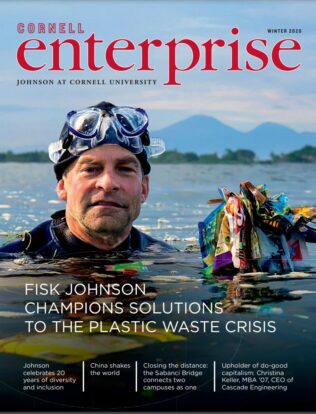
On the evening of January 18, 2011, at the Mid-America Club in downtown Chicago, H. Fisk Johnson '79, MEng '80, MS '82, MBA '84, PhD '86, CEO and chairman of SC Johnson, spoke to 140 Cornell alumni about our planet’s growing crisis of consumption, calling for “disruptive” changes in the priorities and actions of governmental agencies, manufacturers, and the American consumers who use a disproportionate share of the world’s goods.

Johnson’s presentation was the centerpiece of the Johnson Alumni Association of Chicago’s 4th Annual Predictions Dinner, an event at which attendees predict the upcoming year’s Oscar winners, the trajectory of the stock market, the most successful Cornell athletic programs, and more. After being introduced by Cornell University President David Skorton as “a valuable advisor” and “one of the university’s most distinguished alums,” Johnson began by recalling a prediction (in keeping with the evening’s theme) attributed to Albert Einstein: “If the bee disappears from the surface of the Earth,” Einstein said, “man would have no more than four years left to live.”

“Given the fact that honeybees have in fact been recently rapidly disappearing, that’s a pretty eerie prediction,” Johnson said.

While countless species are being decimated, the globe’s human population is approaching seven billion, and the food, shelter, and energy needs of this “human swarm,” are already creating devastating consequences, Johnson said. “It’s hard to imagine as the population continues to grow that at some point we won’t reach a limit to our resources. We need everyone to make some tough choices. And we need to make those choices early, so there’s enough runway to get there when we want to get there.”

To illustrate the challenges to actually creating disruptive change, Johnson recalled the bureaucratic resistance he encountered while attempting to open a wind-powered plant in Holland, and to build a carbon-neutral home in Wisconsin. He expressed his support for more government intervention, as well as more corporate organizations like the Consumer Goods Forum, a recently formed group of major packaged-goods manufacturers and retailers, including SC Johnson, that is committed to developing common “green” standards. “Still,” Johnson added, “it’s a consumer issue, too.” Case in point: American consumers’ insistence on ultra-soft toilet paper, which cannot be produced without harvesting “old forest” wood, and reluctance to use cleaning agent refills, simply because it involves one extra step than they’re used to.

SC Johnson gets 40 percent of its global electricity from renewable sources, and has reduced greenhouse emissions in its facilities 32 percent since 2000. Most recently, Johnson said, the company began an industry-leading policy of total transparency regarding all the ingredients used in its products and has teamed up with an organization called Recycle Bank to give consumers more appealing incentives for recycling.

One key to creating lasting change, Johnson said, will be to change the public’s attitudes on runaway consumption the same way attitudes on smoking and drunk-driving changed in recent decades, and to promote a more community-centric and less materialistic definition of happiness.

In his conclusion, Johnson called on the audience to raise the bar on their own green behavior and to demand that businesses and government to do the same. In parting, he invoked the words of his father, Sam Johnson ’50, the man responsible for setting SC Johnson on its environmentally conscious path decades ago.

“Am I an environmentalist?” the senior Johnson once said. “Yes. Am I a businessman? Yes. But what I am more than anything else is a grandfather who wants his grandchildren to have the same kind of place to live and grow up that I did.”


Bookmark and Share
  • Features
  • |
  • Web Extras
  • |
  • Inside Johnson
  • |
  • Departments
 
"It's hard to imagine as the population continues to grow that at some point we won’t reach a limit to our resources. We need everyone to make some tough choices."
–H. Fisk Johnson '79, MEng '80, MS '82, MBA '84, PhD '86


Rss feedSubscribe to the comments for this page

Comments (0)

Post a new comment:

Name:

Email:

Comment:


  • Johnson Home
  • |
  • Alumni Home
  • |
  • About Cornell Enterprise Online
  • |
  • Contact
© 2013 Samuel Curtis Johnson Graduate School of Management