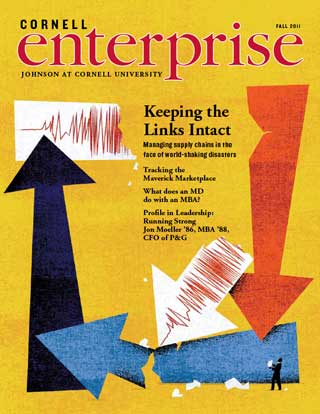
What does an MD do with an MBA?
Three heart surgeons earned Johnson MBAs to add business and leadership skills to their rigorous medical training.
Here's Why.
“Medical school and residency training programs produce physicians highly capable of taking care of
individual patients and doing deep analytic thinking, but they do not prepare doctors for systems thinking
or working cooperatively and collectively in a hospital environment,” says Dr. Robert Alan Lancey,
MBA ’07, heart surgeon and head of the Bassett Hospital Network in central New York state.
Lancey is among a growing number of established MDs who have earned MBAs to get the business
skills crucial to assessing the whole picture, and to bringing about change where needed. He and two
other heart surgeons, profiled here, are graduates of Johnson’s Cornell Executive MBA program, offered
on alternate weekends in Palisades, N.Y.
“Physicians are smart people, and they want to make a difference, but we are in a challenging environment
for them to practice in,” commented Dr. John E. Prescott, chief academic officer at the Association
of American Medical Colleges, in a New York Times story last September about more MDs going for
their MBA degrees. “Most want to modify it, but some want to leave it.”
These Johnson alumni are committed to staying, and they have already brought about positive
change in their organizations.
Dr. Robert Alan Lancey, MBA ’07:
Strong leaders for tough times
Dr. Robert Lancey aims to have a positive impact on the national medical environment. When he first came to Bassett as head of cardiac surgery and heart care programs at the medical center in Cooperstown, N.Y., he decided to pursue an MBA to gain the requisite skills to help control burgeoning medical costs.
“Doctors generate about 80 percent of all costs in healthcare with their pens, when they order tests and procedures,” observed Lancey. “The fact that many don’t have good business knowledge is just shocking. But in med school they are trained to be autonomous individuals taking care of their patients, not taking care of patients in the global view of the healthcare industry.” On the flip side, nonclinical administrators who make big organizational decisions often don’t understand what’s involved in caring for patients.
The “global view” Lancey refers to means tackling the sometimes overwhelming challenges hospitals and medical practices face today, among them reduced insurance and Medicare reimbursements and demands for more efficiency and cost savings from third-party payers, including the government.
What’s needed says Lancey, are “strong physician leaders who understand the clinical world and the professional demands that doctors face, yet also have the ability to bring doctors to the table with non-clinical experts in a healthcare organization, and collectively make it succeed.
“The healthcare environment’s tough right now - with reimbursements going down and a lot of hospitals closing,” Lancey observes. “Doctors and administrators need to sit down and figure these things out together because we’re in it together.”
A career supercharge
“The Cornell MBA opened doors for me in a way I never would have predicted,” says Lancey, who completed his Executive MBA while a full-time, practicing surgeon at Bassett, performing heart surgery five days a week.
The biggest payoff was being appointed to his current position as medical director for the entire Bassett Network, which includes six hospitals and 22 regional health centers over a 5000-square-mile area in central New York State. “I’m now in a leadership role, tasked with the clinical integration of all the hospitals and regional centers — team building, which is what I think an MBA is all about,” Lancey says.
Earning his MBA provided Lancey with the skills he’d lacked and motivated him to initiate change, he says. “I gained an intimate knowledge of finance, marketing, strategic planning, and operations, and the skill set to be a leader in these areas and in the organization,” says Lancey. “I came back to Bassett and performed a complete cost accounting of the cardiac surgery program, which enabled us to see where we could become more efficient, saving money while continuing to provide high quality care. It was revealing, and it helped,” he says.
“My relationship with my CEO also has become more professional,” Lancey says. “I inundated him with white papers and executive summaries, sharing with him my thoughts about how we can benefit the organization, and he’s been open to it.” The MBA gave Lancey a new, broader perspective and has helped him care for patients in a different way — by improving hospital services. “I have learned not only to become a contributing member of the hospital administration team but, more important, how to lead teams and committees,” he says.
Clearly, Lancey’s opinions are more valued by colleagues. Since earning his MBA he has been appointed to the Bassett network’s Business Development Group, Service Excellence Council, and Quality Management Council. On the latter, he works on such issues as patient wait time and how to ensure each patient is treated with respect. “My success in these roles is linked directly to what I learned at the Johnson School,” Lancey says.
Dr. Ramachandra “Ram” Reddy, MBA ’07:
Learning the language of business
Dr. Ramachandra “Ram” Reddy, a cardiac surgeon affiliated with Mt. Sinai Medical Center in New York City, was drawn to heart surgery early on because of its lifesaving potential. “You operate on someone who is dying, someone with no hope of recovery, and the next morning that same person is smiling at you. Doctors who are smitten by it can never do anything else. It’s instant gratification,” he says.
But he was not unaware of his field’s commercial side. “Medicine is big business. Mt. Sinai’s operating budget is over $1 billion a year,” he says. As a physician, he is accountable to everyone in his medical facility, Reddy noted. To be more effective, he wanted to understand the language of business and learn more about what running a medical center entailed, including budgets, insurance reimbursements, facilities, staffing, and people management. “I thought that getting an MBA would help me do that,” he says.
Reddy, who currently performs heart surgery five to six days a week, also envisions spending less time operating later in his career, and becoming more involved in administration. “Having an MBA will be a huge advantage at that point,” he says.
Tools to calculate costs of new technology
Reddy credits his EMBA experience with giving him the knowledge and presentation skills to stand up in front of a roomful of people and make both the medical and financial case for adopting new techniques, technologies, and programs, a skill he calls invaluable. “I’ve been able to ask for and acquire new technology by making the calculations and demonstrating a good return on investment,” he says. In one instance, he showed that even though the technology to do a minimally invasive operation might cost the hospital more in the short term, it enabled patients to get back on their feet sooner, a long-term budget benefit.
Having an MBA also “opened my mind to how people in other fields think,” says Reddy. His classmates and professors have become a valued network he turns to when he needs help on business-related questions. And he’s happy to return the favor. “It’s good to be able to reciprocate when they want my help on healthcare issues,” he says.
Dr. Randall Green, MBA ’11:
Team-leading and business startup skills
Dr. Randall Green, a cardiothoracic surgeon with an entrepreneurial bent, was initially motivated to get an MBA because he wanted the skills to build and market medical devices he knew would improve patients’ lives.
Green, who heads his own private practice and also directs the cardiac unit at St. Joseph’s Hospital in Syracuse, N.Y., grew up in San Francisco and lived in Palo Alto for six years in the 1990s while doing his general surgery and cardiothoracic surgery fellowships at Stanford. “It was an exciting time to be out there, a very entrepreneurial time, and many new medical device companies were starting up,” he says. The climate inspired him to think about launching his own device business.
“We are bred to be technicians and caregivers, but we see a need [for better medical devices] every day at the hospital bedside,” Green says. “The real problem is, how do you go from recognizing a clinical need to taking a product to market? It’s an intricate process. Formal education such as an MBA is a tool that makes all that possible.”
Although Green sought an EMBA at Johnson to get the hard business skills he thought he would need as an entrepreneur, his perspective and reasons for pursuing the degree broadened in January 2011, after he said yes to an offer to become program director of cardiac surgery at St. Joseph’s Hospital in Syracuse, one of the busiest heart programs in New York State.
“It’s the ultimate leadership position for cardiac surgeons, one that allows you to finally apply all those ideas and strategies that you’ve had and make your program the best one,” he says.
But it was not without challenges. “I was now managing dozens of physicians’ assistants in the operating room, the ICU and elsewhere,” Green says. “I wanted them to be passionate about what they were doing, to transform the people who show up every day into a cohesive team.” While that didn’t happen overnight, “I learned observational skills, in a class on managing teams taught by Professor Beta Mannix, that helped me understand better what motivates people. I came to recognize that every individual is different and that success as a team leader wasn’t necessarily about giving someone more money or time off but about reaching a common understanding and shared goals.”
Green didn’t abandon his entrepreneurial ambitions, and he credits his MBA experience with helping him understand how to evaluate new business opportunities in cardiac surgery. “I learned how to ask questions like: ‘How big is the market? How much is the reimbursement? How do I sell the product to hospitals and come up with a financial strategy that looks at costs and anticipated revenues?’”
Being immersed in Johnson’s MBA environment also aided Green when he launched his first medical device company. “We were about to pitch our business plan when a visiting EMBA professor, Steven Gal, a California entrepreneur who had started multiple companies, offered to look it over and gave me a few pointers.”
Now, in addition to his work at St. Joseph’s and his medical practice, Green heads two startups: Secant, which seeks to develop a catheter-based mitral valve repair device; and Vapsys, which plans to make a ventilator-associated pneumonia prevention device.
But perhaps the biggest impact of his MBA is how Green now views his role in fixing some of healthcare’s budget challenges. A class in economics with Professor Robert Frank made him aware that: “We need to be better stewards of our resources. I’ve since transitioned my thinking from treating every patient with everything we have all the time to recognizing that healthcare resources are scarce, and even clinicians have a role in their utilitarian use.
Linda Brandt Myers, founding editor of Cornell Enterprise and freelance writer, enjoys interviewing Johnson alumni about how they are using their MBA degrees.


Post a new comment: