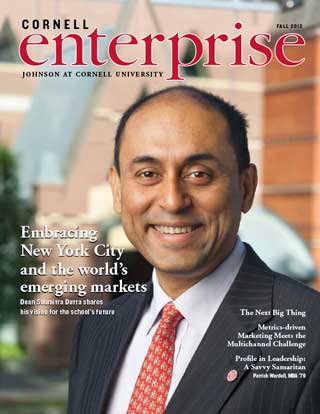
Embracing New York City & the world's emerging markets:
Dean Soumitra Dutta
Envisions Johnson’s Future
Dean Dutta’s vision for Johnson focuses on three key goals: systematically expanding Johnson’s reach and reputation around the globe, beginning with the emerging markets of China, Latin America, and India; expanding Johnson’s presence and programs in New York City; and drawing on Cornell’s strengths to build new, multi-disciplinary programs.
Q:You have stated that growing Johnson’s presence and reputation
globally is a high priority. Can you talk about why that
is so important in today’s world?
Dean Dutta: We have to recognize that we are living in a world
which is different from what it was five, ten, fifteen years ago. The
world has become multi-polar and an executive today has to work
with colleagues, with customers, with suppliers in multiple countries.
So it doesn’t matter which country the executive resides in; the necessity
to work with different cultures, different nationalities, different
organizations is almost a prerequisite for global success today, and in
many cases the executive may have to relocate and live in multiple
parts of the world as the demands of his or her job require.
So global collaboration, global sensitivity, being aware of the
importance of how the economic power is shifting on a global basis
— these are extremely important for all business and executives today.
"Global Begins at Home"
A business school like Johnson has to prepare executives and MBA students for the future. That’s our mission. So we have to be much more global in our perspectives and global begins at home. We have to make sure that our curriculum, our student-body composition, our faculty composition, our staff composition reflects the global nature of the world we operate in. The more diverse, global perspectives we can offer — whether it’s though in-class discussions, immersions, study trips to other countries, visiting executives from foreign companies, or even presentations by domestic executives who have interacted and succeeded globally — these perspectives on the changing nature of the world will help our students and executives be better prepared for the future.A global focus is an inherent component in a variety of different performance-learning approaches we use at Johnson. It’s already present in the fabric of our approach. But there’s certainly more that we can do in that area.
“China, Latin America, and India are the key emerging markets in which we seek to increase Johnson’s global impact.”
If you’re looking at which markets will grow the most in the future, emerging markets are the top of the list. If you want your business to succeed and grow you have to be present in those emerging markets.
A global focus also implies that our faculty members are doing research that extends into other global markets. We are encouraging our own faculty members to conduct research projects internationally, either while on sabbatical leave or some other kind of short research stays in foreign partner institutions. We support those research projects through funding from the school, and while faculty members are certainly free to choose any part of the world, any region of interest, for their own research, we are also trying to build special research capability in a few markets of interest. So, we are encouraging faculty members to do research in these markets; we are trying to hire more faculty based on research interests in these markets; and we are building more partnerships and institutional links with universities in these markets.
For example, in India many of our faculty members are working on research projects with colleagues in IIMs [Indian Institutes of Management], and we have colleagues working with leading universities in China on joint research projects. So we’ll try to establish more of these joint research projects and collaborations going forward.
We are also trying to get more executives and executive MBA students from global markets into our programs, and build on our current interactions. For example, when executives that we bring from the China Europe International Business School (CEIBS) in Shanghai come here, we mix them with students in our Cornell Queen’s Executive MBA program; in that way, we can have a very nice blend of learning and approaches among Chinese and North American executives. Both sides learn from each other. It’s a good example of how we can try to create more occasions and more opportunities for global interactions in our programs.
Q:I understand that, together with your management team,
you have decided to focus first on China. Why?
Dean Dutta: We can’t take on the whole world at the same time,
so we have chosen to focus on China initially. I really want to create a
holistic strategy for approaching China, and then translate and move
this approach to other markets in the world.
China is very important in the world today because it is the
second biggest economy in the world. In terms of human talent, it is a
great source of qualified students and top researchers. It is also a very
interesting country in terms of research: new research problems, new research approaches, and new questions that have to be addressed.
So from the point of view of global importance, human capital, and
interesting research problems, it is a very important market for everyone
in business to consider. And given that our client and customer
base includes executives and MBA students who will work in global
corporations, they will have to understand and deal with China as
part of their jobs and future careers.
Q:Can you expand on how you see the different research
challenges and problems in China?
Dean Dutta: In China, you need to understand the role of stateowned
enterprises and the role of the government. Researchers need
to understand the special needs of that context and what it means for
companies, both foreign and domestic, to grow and compete successfully
in such a market. If you look at the issues around innovation, a
lot of the innovation needs in China are different: there are masses of
people in a very large country at different price points of affordability.
How do you innovate for such a large market?
Let’s take the example of healthcare. If you want to provide
quality health care to the entire population of China you cannot do
so using the models and the methods of the West. It will just simply
be prohibitively expensive. So how do you come up with innovative
healthcare models that are able to provide affordable, quality healthcare
to a large population? You have to fundamentally rethink and
innovate.
If you think about sustainability, if you think about raising
the quality of life of Chinese citizens, you cannot just apply Western
approaches because it will be too heavy a cost for planet Earth to
pay. We are forced to innovate and create more sustainable solutions.
That’s why China offers a very fertile ground for new research approaches
and new research questions.
We’ve asked four of our Chinese colleagues — Johnson Professors
Ya Ru Chen, Eric Yeung, and Ming Huang, as well as Chen Jian,
a colleague from Cornell’s history department — to come up with a
first draft proposal of Johnson’s strategy in China.
Johnson in NYC
Q: You have expressed keen interest in building Johnson’s presence
in New York City, establishing it early on as a key player
in the Cornell NYC Tech campus. Why is this important for
Johnson now?
Dean Dutta: The focus of Cornell NYC Tech is technology
commercialization, and clearly Johnson is going to be a major part of
this effort, in partnership with computer science, engineering, and
other departments in the university. This whole initiative is unique.
It’s probably the most innovative project in higher education today,
bringing together a major global university together in partnership
with the city government of a unique metropolitan area and with local
industry. The end result everyone expects will be a lot of new ideas
brought to market, successful new ventures, and a renewed revitalization
of the economy using technology and innovation, which is the
lifeblood of the modern economy today.
Participating in this exciting experiment is an important part
of Johnson’s future. It is the opportunity to take part in creating a
new business innovation ecosystem. Today there are many good
business schools inside a university, but no top business school in the
context of a technology campus. New York also represents a unique
platform for Johnson to expand in many ways — to innovate and
create new ways of looking at business education in the special context
of technology and entrepreneurship, to form new partnerships with
local industry and local business players, and to tap into the unique
talent pool in the New York area. The range of opportunities that
exists for Johnson in New York is limitless. Our challenge is to
selectively identify those that make the most sense for us, seize the
opportunity, and execute that.
I’m very hopeful that through the creativity of our faculty and
our students, in combination with our partner companies and alumni,
we will be able to create unique, new combinations of products,
services, and projects, such that we really position Johnson in a very
strong manner for the future.
Q: It sounds like you are intent on expanding the school?
Dean Dutta: Certainly the school will grow; that’s a normal
part of the process. We have grown a significant amount over the last
ten years and over the next ten years we will continue to grow. But
that’s also because the range of opportunities ahead for top business
schools is growing. Our peer schools are also going to grow; this is
how the market is evolving. And New York City gives us a chance to
be unique as we grow. So it’s not just a question of growth for the sake
of growth; it’s more a question of growing such that we are able to add unique value, create unique knowledge, and have a fundamental,
important impact on our key groups: prospective students, executives,
and companies. And I do think that the Cornell NYC Tech campus
will give us a platform for exploring new avenues. It’s a really exciting
project. It’s a game changer for the school.
We can’t even imagine today what all we may want to do in
New York five years from now. Just think about technology itself. If
you go back ten years and you try to predict what technology looks
like today, you would have failed. Even today we cannot predict
what technology will look like ten years from now. We can think
and make guesses but it’s very difficult, so we have to be open, we
have to be willing to experiment, we have to be bold, and we have to
fundamentally move forward with the best support ecosystem that we
can create, and innovate.
Q: Why did you decide to become dean of Johnson at this
point in time and what attracted you both personally and
professionally to Johnson?
Dean Dutta: I was very happy and well-settled in INSEAD and
I’m very grateful for the 23 wonderful years I spent there; it’s a great
institution. But when the search firm came and approached me about
the Johnson opportunity I had to listen to them seriously because
Cornell is a great university and the privilege of leading a top business
school like Johnson was something I just could not ignore. And the
more I spoke with them, the more I interacted with Johnson faculty
colleagues, the more I understood the deep strengths of the institution:
the strong community spirit, the high quality of faculty and
research, the way Johnson interacts with the rest of the university, and
Cornell’s strength all across its different, discipline-based schools.
All these elements were very important in my decision, because
I felt that, given these unique assets, we could really create something
new inside this space. Certainly, news of the Cornell NYC Tech campus
gave me an additional boost of enthusiasm for the project, because
that provides a unique platform for doing something new, something
innovative, something very much linked to my own research interests
in technology and innovation. Putting all these things together, I
thought this was a very unique opportunity to lead a great business
school at an exciting time in an exciting context, and that’s the main
reason why I decided to make this jump. And I’m very happy I did.
Q: You are a member of the World Economic Forum’s Davos
Circle, and you play a lead role in preparing and publishing
the annual Global Innovation Index, a publication you
founded, which ranks 141 countries and economies on the
basis of their innovation capabilities and results, for the
World Intellectual Property Organization. Will you continue
to be as active in these roles?
Dean Dutta: I certainly hope to be active in these and in other
global networks. My level of activity will change, given my new
responsibilities at Johnson, which are my priority. But I do intend to
continue to co-publish the Global Information Technology Report with
the World Economic Forum and the Global Innovation Index with the
World Intellectual Property Organization. These are important elements
of my own professional profile that will also enhance Johnson’s
profile in the global context.
Q: How do you like living in Ithaca?
Dean Dutta: Ithaca is a beautiful place, with the lake and the
trails and the wineries. Here, my wife Lourdes and I are able to
combine the best of two worlds: the best of a rural environment and
a very intellectual, modern, high-profile academic environment that
is connected to the global world. With today’s technology we can
stay in touch easily with our daughter, Sara, who is doing her PhD at
the University of Oxford, and with our families in Spain and India.
I think it’s a tremendous advantage to be able to have the best of two
worlds. Lourdes and I are very happy to be here and be part of the
unique Johnson community.


It will be interesting to know how Johnson Business School will meet the challenge of preparing students for future business in this age of rapid technological innovation and change, globalization, and alienation from customers with increasing share of e-business.
Post a new comment: