FALL 2012
  • Features
  • |
  • Web Extras
  • |
  • Inside Johnson
  • |
  • Departments


Bookmark and Share

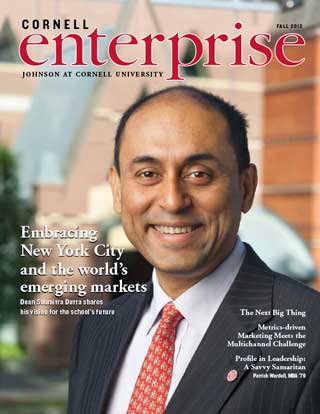
The Next Big Thing


By Merrill Douglas
Giving customers what they need — whether or not they know they need it — is the best way to score a big success with new technology.


In 2001, inventor Dean Kamen announced that his Segway Personal Transporter would spark a transportation revolution. In 2007, Apple announced that it had reinvented the phone — and would enchant consumers — with its new cell phone/music player/Internet device. Only one of those claims turned out to be right.

Nowhere is it written that a great-sounding concept must beget a blockbuster product. Three out of four ideas don’t even survive the development phase, says Bob LaPerle, visiting lecturer of marketing at Johnson. “And of the products that are launched, one-third fail.”

Products that solve important problems, or meet previously unmet customer needs, are five times more likely to succeed than other new offerings, says LaPerle, a senior marketing executive whose career — largely at Eastman Kodak — has focused on new product development, integrated marketing, global startups, and turnaround operations. “They usually gain four times the market share, and they usually have four times the profitability of products that are not truly differentiated.” Figuring out what customers need, and how to serve those needs in a compelling way, is the age-old challenge of marketing. For companies that sell innovative technology, this challenge is especially tough. After all, a few years back, how many of us knew we needed phones that we could use to read magazines or pay taxi fares?

How do you generate desire for a new device or capability that no one has heard of? How do you make sure that a novel technology product is the kind that customers line up to buy?

What Comes First

Some successful innovation starts in the lab, and sometimes it occurs well before a clear need appears. Fiber optic cable is a case in point. “Corning invented low-loss optical fiber in 1970,” points out Phillip Bell, MBA ’07, product line manager, new business development, at Corning Inc. in Corning, N.Y. But it took over a decade for the market to catch up with this new capability.

Only after the U.S. government broke up the AT&T monopoly in 1984, and new entrants such as MCI and Sprint started building new telecommunications infrastructure, did customers discover a need for high-performance cable that cost less to deploy than copper wire. When that demand emerged, Corning stood ready to deliver.

Innovations in pharmaceuticals and medical devices sometimes spring from internal engineering labs at large health care firms, says Alisa Jirut Craig, MBA ’02, founder and managing director at BioMedika Consulting in Glenwood, Md. BioMedika provides marketing services to companies in the medical device, biotechnology, and health care industries.

“They have a group of scientists and engineers who don’t work at all with the marketing people or the business side,” says Craig, who also has worked for several large health care manufacturers. “They run a think tank where they develop ideas based on the company’s technology expertise.” Eventually, of course, marketing professionals step in to fine-tune the concepts and determine their potential with customers.

Starting with a technology breakthrough, and then finding a need it can fill, does sometimes produce a successful product, says LaPerle. “But most of the time, I think it works better when you have a deep understanding of unmet needs, problems, and frustrations among a sizeable target segment, and then you try to find the technology that would meet those needs.”

Health care companies take that route, too. A surgeon, for example, might approach a manufacturer with ideas about how to make a stent that is easier to insert or manipulate through the arteries, says Lori Glick Burke, MBA ’03, founder and principal of Strategion Consulting in Pembroke Pines, Fla., which provides strategy development and marketing consulting services to health care and life science companies and often collaborates with BioMedika.

But it often takes an outsider’s eye to spot a product opportunity. Even when marketers ask customers directly what they need, the answers may require translation.

“Sometimes what they say is different from what they really face,” says Deepak Kallakuri, MBA ’11, product marketing manager at Cognex, a Natick, Mass. firm that makes machine vision systems used in factory automation. “It’s all about peeling the layers away to see what their true needs are.”

To illustrate, Kallakuri describes a production line that moves bottles past a smart camera system made by Cognex. The camera checks to make sure that the print on each bottle’s label is sharp and clear. When it finds a blurry label, the system displays an alert on a screen, prompting an employee to change the cartridge in the printer.

Customers using the Cognex camera for this and similar purposes had not complained about the format of the alert. But as he discussed the process with customers, it dawned on Kallakuri that employees needed displays that they could understand at a glance. “I realized that putting pictures on the screen instead of text might help,” he says. “When I brought that point up, customers said, ’Yes, that makes sense.’”

Job Shadowing

In their earlier careers at large health care firms, Burke and Craig often headed to the surgery suite for new product ideas. Each would spend time watching surgeons and their staff at work. “After you do that for a few days, and you really understand it, you begin to see inefficiencies that surgeons don’t necessarily notice because they are focused on the medical procedure and the patient on the table,” Burke says. “Those inefficiencies are ripe opportunities for improvement.”

Erin Daly, MBA ’07 (E), product manager for travel products at Google in Cambridge, Mass., also favors that sort of job shadowing. Watching how end users perform their jobs, she asks numerous questions to understand why the process runs the way it does.

According to Daly, who also has worked for several other business application developers, users tend to concentrate on how to make incremental improvements. They rarely consider what would happen if they changed the process completely. “I’m always trying to be the voice to challenge the current functions and ways of doing things,” she says.

Daly says she favors brainstorming with customers as well, to clarify customers’ objectives and discover better ways to reach those goals.

At Corning, Bell also spends a great deal of time probing customers’ needs — for example, while researching new markets for a product called Corning Gorilla Glass.

Electronics manufacturers have embraced this thin, lightweight, damage-resistant material for uses such as touch-screen displays.

Bell’s challenge is to discover problems that the Corning product might solve for other industries.

He takes a different approach for each target market. When talking to automakers, for instance, he might focus on upcoming mandates in Europe and the U.S. to improve average fuel efficiency.

Since lighter vehicles use less fuel, Bell talks about reducing weight by replacing today’s heavier soda lime glass with Gorilla Glass. “I’ll go to an OEM [original equipment manufacturer] and say, ’How much would you pay to have one pound, or one kilogram, reduced from your car?”

Who Wants This?

Whether a company is seeking new buyers for existing technology or introducing something brand new, finding a product idea to solve a problem is just the start. The company also must assess the size and quality of the potential market, to see if the opportunity is worth pursuing.

In his 1991 book, Crossing the Chasm: Marketing and Selling Disruptive Products to Mainstream Customers. Geoffrey A. Moore first described a predictable sales curve that occurs when a technology company launches something genuinely new.


“When I worked as a product manager, we typically did this by building a solid storyboard and presenting the idea to a subset of prospects to get their feedback,” says Kishore Bhamidipati, MBA ’05, director of product marketing at NetSuite, a provider of cloud-based enterprise resource planning (ERP) software in San Mateo, Calif.

Several years ago, for example, while working as senior product manager at Mercury Interactive (now part of HP), Bhamidipati helped to develop the idea for a new tool for software developers. The tool improves their ability to test applications before they release the software to users. Developers must test their applications under conditions that match the real-world environment as closely as possible. The software might work well for five users in the lab, for instance; but when 2,000 corporate users try to access the system at once, it crashes.

Few developers, however, can afford to deploy 2,000 workstations for a test.

Mercury proposed a virtual labmanagement tool. Customers loved the idea, Bhamidipati says.

Taking input from a ten-customer advisory board, Mercury refined the concept and then hit the road to make presentations.

After that came talks about how much customers would pay for such a tool, based on the benefits it offered. Eventually, the product management team presented the business case to upper management, and a new product was born.

Even when a product offers a perfect solution for customers, and even when that product sells well at the start, another obstacle stands in the way of real market success. That obstacle is a chasm — the one that Geoffrey A. Moore first described in his 1991 book, Crossing the Chasm: Marketing and Selling Disruptive Products to Mainstream Customers.

According to Moore, when a technology company launches something genuinely new, sales follow a predictable curve. First, a small number of “innovators” — the technogeeks — snap up the product. Then, a larger number of “early adopters” buy in. Members of this second group don’t love technology for its own sake, but they’re quick to grasp the benefits that a novel product provides.

While those early sales make for an encouraging launch, the product won’t really take off, Moore says, until large numbers of mainstream buyers — the “early majority” and “late majority” — start to step forward.

On the sales curve, the gap between the early adopters and the early majority is huge. If a company doesn’t understand how to attract the early majority, the product’s climb up the curve could end abruptly at the chasm.

Mainstream buyers expect different things from technology than innovators and early adopters, says LaPerle. “If there’s a buying experience, a service experience or an educational experience, those experiences have to be well done and well integrated with the product.” For example, mainstream users who run into a software problem don’t want to search online for solutions; they want quick answers by phone.

Majority buyers also tend to shop in different distribution channels and respond to different advertising media than innovators and early adopters, says LaPerle. “You need a very focused marketing strategy to cross the chasm and start attacking the early majority.”


Getting Accross

Strong recommendations from influential sources may provide a bridge. That’s what happened for Paul Kaplan, MBA ’87, during the period when he worked for Motorola.

The company had figured out how to embed electrically erasable, programmable, read-only memory (EEPROM) in microcontrollers — a standard practice today, but a breakthrough at the time. Although Motorola promoted potential use cases for the new capability, it was hard to get the broad customer base to understand the merits of the technology.

“It wasn’t until we had the first few early adopters signed on that we really started gaining traction,” says Kaplan, who now handles speech and language technologies in the new business team, Perceptual Computing, at Intel Corp. in Santa Clara, Calif.

Motorola invited its early adopters to discuss their intriguing uses for embedded EEPROM at a seminar for customers from around the world. “We essentially bootstrapped the technology into our whole customer base that way,” Kaplan says.

In a similar manner, physicians who are early adopters can help to seal the success of an innovation in health care. “When you launch a product, you want these doctors to go to major conferences, talk about it, get it mentioned in professional journals, and get it into their practice,” says Craig.

For Bhamidipati at Mercury, the leap across the chasm started with a focus on a few early adopters. “I would keep them abreast of the product development. And when I was closer to an alpha or beta version, I would give it to them so they could start testing it and giving us feedback,” he says.

Eventually, the most interested customers provided long lists of features that they wanted to see included. “We’d take that into consideration, because we wanted them to be successful and happy with the product,” he says. In return, Bhamidipati asked those early adopters to talk up the product in webinars and panel discussions and discuss its advantages with analysts and customers. “Getting them to be successful is the cornerstone of taking the product to the next level,” he says.

Like Bhamidipati, Daly finds that early versions of an innovative offering help to build excitement among key customers. “I’ve seen that be very successful, having incremental prototypes on a monthly basis, or every six weeks, to show them exactly how they interact with the product,” she says.

In business-to-business marketing, the key is to give those prototypes not just to managers, but to the people who will use the product in their day-to-day work, Daly says.

“If you can win over the end user, then the adoption just naturally happens.”

Marketing a breakthrough product for consumers is a little trickier, she says. “You might be creating a new experience for a market that doesn’t even exist.”

Matching new technology to customers’ needs is often the easy part of the marketing equation, says Daly. “My experience has always been that the challenge is getting people to embrace the change.” An office worker who has always used a keyboard and mouse, for example, might have trouble understanding the advantages of switching to a touch screen.

That’s part of the reason prototypes are so helpful, Daly says. “I think people are instinctively visual. Showing something working, and showing how it’s working, makes a big difference.”


Merrill Douglas writes about a wide range of business and government-related topics for trade magazines, university publications, nonprofits, and corporate clients from her home on a country road in upstate New York.

  • Features
  • |
  • Web Extras
  • |
  • Inside Johnson
  • |
  • Departments


Rss feedSubscribe to the comments for this page

Comments (1)
Posted by Subha Ramiah on January 27, 2013:

Excellent Article. To add to Erin Daly's point, getting the innovation out fast to the customer's had is one of the key factors which makes the innovation successful. Often the users "hack" the product to meet their need which was never the intent of the original design. This makes the product mature from 1.x to x.x in continuous improvement cycle.!

I am a big believer in 30-60-90! The idea has to hatch out in 30 days with alpha, become beta in 60 and 1.0 in 90 days!
In this information explosive age 1 week could decide the "success" vs "failure!
Subha Ramiah
MBA'07 (E)
Innovator with a technology heart and business brain in Healcthcare

Post a new comment:

Name:

Email:

Comment:


  • Johnson Home
  • |
  • Alumni Home
  • |
  • About Enterprise Online
  • |
  • Contact
© 2013 Samuel Curtis Johnson Graduate School of Management