SPRING 2010
  • Features
  • |
  • Web Extras
  • |
  • Inside Johnson
  • |
  • Departments

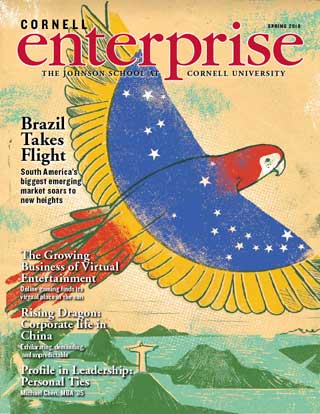
Will South America’s biggest emerging market finally become a top player?

Brazil Takes Flight


By Linda Brandt Myers

International entrepreneur Stan Ting, MBA ’01, believes Brazil is the place to invest in now, and it’s not just because he grew up there — or launched his highly successful business development firm, Jade Ventures Inc., from there. Nor is it because Brazil has been chosen as the site for both the 2014 Soccer World Cup and the 2016 Olympics — although those developments add to its current allure and will be the country’s “coming-out-party,” introducing it in style to the rest of the world, Ting predicts.

Go to page >>   1 | 2 | 3


“Brazil is the most culturally diverse and integrated place in the world, more so even than New York City.”


— Stan Ting, MBA ’01, Jade Ventures Inc.


“Brazil needs to invest in education, mostly in primary to high schools, and other key areas to achieve continued economic success.”


— Richard Ku, MBA ’00, Kraft Foods, Brazil

“In the ’80s and ’90s,” says Ting, “a lot of the pundits said Brazil was always the country of tomorrow, never of today, but I think now is the right time for Brazil. We’ve shown the world that ours is a mature, growth economy.”

All the Right Numbers

What Ting believes in most is numbers, which, he says, are all in Brazil’s favor these days. The country is one of three in the world (China and the U.S. are the others) with a land mass greater than 5 million square miles; a GDP approaching 1.5 trillion U.S. dollars (official exchange rate); and a population close to 200 million, he points out. “That indicates we have vast natural resources; a large economy; and a wide consumption base, with many families who still need to buy their first TV, car, or refrigerator.”

Signs of Brazil’s burgeoning success can be seen in the major business press too. “In the face of the worst global economic crisis since the Great Depression, Brazil’s economic output dipped a tiny two percent in 2009, and is expected to grow by as much as six percent this year,” the Wall Street Journal trumpeted this March. Experts predict Brazil will become the world’s fifth-largest economy within the next 15 years, overtaking Britain and France, wrote The Economist last November. To demonstrate that Brazil’s moment is now, the issue also featured an image of the giant statue of Jesus that overlooks Rio de Janeiro’s harbor, adapted to look as if it were blasting off like a rocket ship from its mountain perch. Icing on the cake was Forbes.com’s March prediction this year that charismatic Brazilian, Eike Batista, who has investments in his country’s extensive mining and oil resources, is on his way to becoming the world’s richest man.

An Adventurous Venture

Ting has done business in places other than Brazil, notably a stint at former U.S. investment banking firm Donaldson, Lufkin & Jenrette. But he saw opportunities in his home country that made him return there. Jade Ventures capitalizes on Ting’s dual heritage (his Chinese parents immigrated to Brazil) and multiple interests (the firm has offices in São Paulo and Hong Kong, where he does business, and New York, where he lives), he says.

“In venture capital,” he explains, “you always have two major risks: the product risk and the market risk.” The idea behind Jade Ventures is to remove the product risk by taking a quality product that has sold well in one place and marketing it in another place where Ting is so confident it will do equally well that his firm invests in it for a limited time. Here’s how one such venture worked.

“We had a client in Hong Kong who made a good product called Air Cooler that cooled a room using water. It is not an air conditioner,” says Ting. “We studied the product’s potential competitiveness in Brazil, did the market research, and found a Brazilian partner who had some experience in that area. We told our Hong Kong client: ‘We think Air Cooler will do well in Brazil, we’ve found a great partner to run the business there, and we want to invest in it. In five years, if you want to buy the business and distribution from us, we’ll sell it to you and become a minority owner.”

The list of successful companies that Jade Ventures has helped launch is long, and includes everything from truck tires and vehicle parts to biotechnology to promotion of Brazilian football at the prestigious Hong Kong Jockey Club, a betting venue.

The Country That Has Everything

Brazil may be the right place for Ting, who is deeply familiar with his country’s culture. But is it also a good fit for larger multinationals, investment firms, and others?

“Brazil has everything,” asserts Jan Katz, a Johnson School faculty member for over two decades, who now teaches international marketing and management at Cornell’s School of Hotel Administration. “A strong location with good port systems, strong commodities production, particularly in the extractive industries. It has a large population that could be trained, and an extremely creative culture. But it has had potential for sixty years,” she adds. “The real question is, why hasn’t it grown before?” She notes that the country has a history of hyperinflation, which has wiped out its middle class more than once.

Overcoming the Inflationary Past

“Brazil’s current success started in 1994, when [then-President] Fernando Henrique Cardoso’s government tamed runaway inflation and debt and brought discipline to public finances by stabilizing the currency and economy,” says Richard Ku, MBA ’00, finance manager for Kraft Foods in Brazil. “It also helped that the country’s economy was opened to foreign investments.”

The highly popular Luiz Inácio Lula da Silva followed Cardoso as president and has been able to keep the country stable and growing, despite initial worries by foreign investors about his left-wing leanings. Of the five candidates vying for Lula’s job when he steps down following 2010 elections, the two strongest, Dilma Rousseff and José Serra (who holds a Cornell PhD in economics), are expected to continue his successful policies for growth, says Cristina M. de Andrea Tamaso, MBA ’08, an associate with Banco Itaú BBA’s investment banking project finance group.

“Brazil was able to get its investmentgrade rating about two years ago, which made a big difference,”says Luiz Gustavo Tavares, MBA ’00, senior banker for debt capital markets and syndications with Banco Itaú BBA.

Indeed, the country has been one of the bright spots in the current economic downturn, and its fiscal policies are part of the reason why experts expect it to do comparatively better than other emerging markets. “By the time the crisis hit, Brazil’s central bank’s reserve requirements were high, and the banking sector was strictly regulated,” said Makhtar Diop, World Bank country director for Brazil, on a PBS Newshour program in March 2009.

“As in India, Brazil’s central bank was very responsible and ensured that banks were not free to do whatever they wanted, such as buying instruments of dubious quality,” notes Johnson School visiting professor Melvin Goldman.

Continued on page 2


Bookmark and Share
  • Features
  • |
  • Web Extras
  • |
  • Inside Johnson
  • |
  • Departments


Rss feedSubscribe to the comments for this page

Comments (0)

Post a new comment:

Name:

Email:

Comment:


  • Johnson Home
  • |
  • Alumni Home
  • |
  • About Enterprise Online
  • |
  • Contact
© 2013 Samuel Curtis Johnson Graduate School of Management