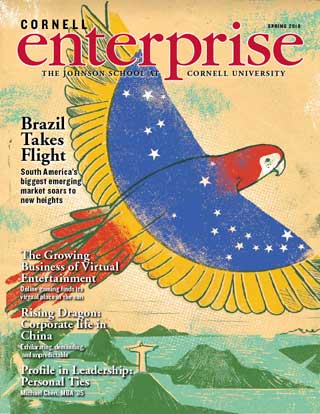
SPRING 2010
  • Features
  • |
  • Web Extras
  • |
  • Inside Johnson
  • |
  • Departments

Profile in Leadership

Personal Ties

Michael Chen, MBA ’85 President and CEO, GE Capital – Media, Communications and Entertainment

by Merrill Douglas

When Michael Chen took his first sales position, he really started loving his career. “I never tracked how many hours I worked or how many hours I spent on the road,” he says. “I was working weekends. But it wasn’t work anymore.”

Chen’s mandate in that job, at GE Capital Aviation Services (GECAS), was to lease aircraft to airlines. But his mission was to forge human ties. He loved listening to customers, learning about their problems and needs, earning their trust, and discovering new ways to help their businesses grow.

Chen’s mission is the same today, and his passion for that role is a major element in his success as a leader.

Since 2007, Chen has served as president and CEO of GE Capital — Media, Communications and Entertainment, which provides financing to companies in industries such as cable, wireless, TV and radio, outdoor advertising, and entertainment programming.
Go to page >>   1 | 2


"The first time I visit clients, we spend an hour or two making no presentation about what we do,” Chen says. Instead, the team listens. “We try to understand what they do and what their customers are like, and understand the business model.”

“We’re also making equity investments in digital media,” he says. “That’s the area that’s going to replace a lot of the traditional media over time.” This strategy involves working with sister company, NBC Universal, though the jointly owned Peacock Equity Fund, to buy stakes in promising ventures such as online gaming service, Bigpoint, the medical reference site, Healthline. com, and BlogHer, an online community for women. When Chen and his team approach a new customer to talk about financing or an equity investment, the most important tool he brings to the table is his talent for personal connection. The tool he usually leaves at home is PowerPoint.

“The first time I visit clients, we spend an hour or two making no presentation about what we do,” Chen says. Instead, the team listens. “We try to understand what they do and what their customers are like, and understand the business model.” It’s not until the second or third meeting that Chen and his team start suggesting solutions. Even then, they don’t make a straight sales presentation. “I like to have a discussion, spending less time on PowerPoint and more on dialogue,” he says.

That give-and-take uncovers valuable information. Even when these conversations don’t pay off in immediate business, they lay a foundation for the future.

“Michael was very good — and I’m sure he still is — at building relationships when there are no deals to do,” says Ken King, a retired GECAS executive who reported to Chen there starting in 1999.“That’s when you get to know the people, and that’s when you get invited to do the deals.”

Talk Uncovers Opportunity

Deeply rooted relationships served GECAS and its customers well, for example, after the terrorist attacks of September 11, 2001. As vice president and general manager, North America, at GECAS, Chen knew that his customers — the airlines — were hurting badly. Passengers weren’t flying.

“The last thing North American airlines needed was more aircraft leases from us or any other lessor,” Chen recalls. In fact, airlines wanted to break their leases and reduce their fleets. At the same time, however, GE offices abroad were reporting that the airline industry overseas was booming. “And they had a huge demand for aircraft.”

So GECAS let some North American airlines end their leases without penalty. The company then offered the returned planes to overseas airlines, which gladly paid a premium.

GECAS spotted this opportunity thanks to its close ties with the airlines, Chen says. “If we had waited and had not been talking to our customers, other lessors would have found out about it, and the price we got internationally might not have been as attractive.”

Conversations with airline customers also revealed a second opportunity for GECAS. “We found out that, because of 9/11, they were running out of cash,” Chen says. So, using planes that the airlines owned outright as collateral, GECAS offered them loans. It was a classic win-win. The airlines shed unwanted planes and got some much-needed cash. GECAS gained profitable leases overseas and also took on lending as a new line of business.

Robert Milton, president and CEO of Air Canada during the post-9/11 crisis, recalls vividly how Chen threw himself into the search for solutions for his customers. He remembers walking through a shopping center with his family late one evening during that time, talking on the phone with Chen.

“If you’re the sales guy for a leasing company, you can turn the phone off if you feel like it,” says Milton, now executive chairman of the holding company Air Canada Enterprises. “This guy was available around the clock.”

Besides making himself accessible to customers, Chen earns their trust by delivering on his word. Keeping promises — even the smallest — is a basic principle. “If I say I’ll call someone back the same day, I’ll make sure I don’t leave the office until I do so,” he says. Chen also is tireless in pursuit of information that will help him fashion a deal that works for both GE and its customer. Jeff Potter, now CEO of Exclusive Resorts, recalls meeting Chen in 1995, shortly after Potter joined Frontier Airlines as CEO.

Continued on page 2


Bookmark and Share
  • Features
  • |
  • Web Extras
  • |
  • Inside Johnson
  • |
  • Departments


Rss feedSubscribe to the comments for this page

Comments (0)

Post a new comment:

Name:

Email:

Comment:


  • Johnson Home
  • |
  • Alumni Home
  • |
  • About Enterprise Online
  • |
  • Contact
© 2013 Samuel Curtis Johnson Graduate School of Management