SPRING 2011
  • Features
  • |
  • Web Extras
  • |
  • Inside Johnson
  • |
  • Departments


  Bookmark and Share

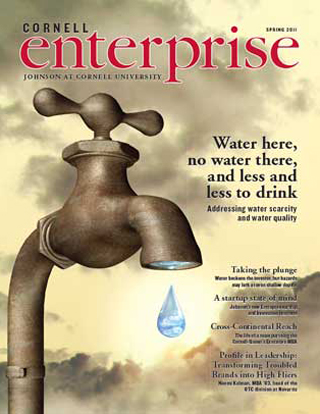
Water here, no water there, and less and less to drink

Addressing water scarcity and water quality


By Doug McInnIs
Source: Map, Fresh Water Availability, from Natural Resources – Fact Sheet 2009. Reprinted with permission from the Food and Agriculture Organization of the United Nations.
Water covers more than 70 percent of the Earth, and yet there is not enough. Most of it is too saline for drinking or industrial use. Some of it is laced with toxins, pathogens, or both. Often it is simply in the wrong place. Antarctica, a continent almost devoid of people, is covered in fresh water, but it’s frozen in great sheets more than two miles thick. Meanwhile, Egypt’s 82 million people live in a land that is 94


From Top Left:
1)Illustration by Jean-Francois Podevin.
2)Water.org celebrating a project success, “El Agua da Vida” (Water is Life), in Honduras.
3)Water is being distributed by an African Union-United Nations Hybrid operation in Darfur (UNAMID) contingent from Rwanda in Tora, Northern Darfur. The closest water source is 1.5 hours away and donkeys are regularly used to transport water to the village (Sudan, 2009). UN Photo/Olivier Chassot
4)Top: Contaminated water in Karial slum, one of the urban slums of Dhaka. According to the World Health Organization (WHO), contaminated water is the cause of 5 million deaths every year. (Bangladesh, 2010). UN Photo/Kibae Park


A Primer on Water scarcity

  • One out of every five people on earth lives in areas where there is not enough water.
  • Water scarcity forces many communities to transport water long distances. In many countries, the arduous job of hand carrying heavy water containers falls to women and girls.
  • Water scarcity forces some communities to use untreated wastewater to irrigate crops. This waste- water may be polluted with chemicals or laden with pathogenic organisms.
  • More than 10 percent of the world’s population eats food grown with untreated wastewater.
  • Water shortages have spurred people to store water in their homes, creating a breeding ground for mosquitoes carrying malaria, dengue fever, and other diseases.


Source: World Health Organization


Christina Keller, MBA ’07, in Comyagua, Honduras, with a local pastor who is helping get filters into the village. “The water source they have is a hole in the dirt road that bubbles up a turbid water; they also have intermittent tap water that sits in a large sink and col- lects bacteria,” says Keller. “The family we installed the filter for was very sad because their baby had a parasite. They were very happy to get the filter so that they wouldn’t get sick.”


Fresh thinking for sustainable solutions

Johnson’s Business of Water Affinity Group (AG), part of the Sustainable Global Enterprise Club, aims to drive awareness of the challenges facing global water supplies, and to identify how private enterprise can address these. The group fosters education through its newsletters, guest speakers, facility tours, and by sharing information about related career opportunities.

Several Water AG members participated in the 2011 Hult Global Case Challenge, a call to action for the world’s brightest business school minds to tackle the world’s most pressing issues. The event, held in partnership with the Clinton Global Initiative and Water.org, focused on developing solutions to the global water crisis and sharing them with Water.org.

The Hult Challenge offered participating students a unique opportunity to leverage their experience and developing knowledge in sustainable technology and business applications to form practical, implementable ideas. Team members brought experience in water policy, sustainability, marketing, infrastructure design, and finance to the table, and also tapped Johnson faculty, students, and alumni who work in water- and development-related fields to develop centralized, scalable, entrepreneurial, and venture capital-backed solutions to accelerate Water.org’s mission.

In addition, Water AG members are working to upgrade AguaClara’s Web site (see p. 20), and they continually seek out new sources of information. For example, they organized trips to New York City and Washington, D.C., to meet with leaders from several organizations concerned with water quality and scarcity, including Vestergaard Frandsen (maker of the Life Straw), Resources for the Future, the U.S. Department of State, Accenture Development Partnerships, Acumen Fund, and the U.S. Environmental Protection Agency. On campus, they coordinated conversations with numerous faculty members and alumni who have extensive knowledge on the water crisis, and led a group of students on a tour of a water facility at Cornell. And they are forging ties with a related AG, focused on agriculture, in planning events for the fall. Stay tuned!

— Jenna Hobocan ’07, MBA ’12
Johnson’s Hult Global Challenge team (left to right) Ryan Barba, MBA ’11, John Galvan, MBA ’11, John Tauzel, MBA ’12, Agata Kostecka, MBA ’11, and Jenna Hobocan, MBA ’12, applied market theory to today’s global water crisis.

percent desert. Governments have long tried to solve water shortages with top-down solutions, but it may be that the best solutions come from the bottom up.

Water scarcity is an issue that links much of the world. But a common issue doesn’t imply a common solution. What works in Israel may not fly in rural India.

“There isn’t one water problem, there are thousands of different water problems around the world,” says Stuart Hart, the SC Johnson chair in Sustainable Global Enterprise. Each may require a different solution, and Hart suggests that planners start at the bottom. “Any solution will have to involve local people. I don’t see this as a problem that lends itself to a single top-down solution.”

This idea has begun to permeate the ranks of government, business, and non- profit organizations as they collectively grapple for sustainable solutions to water scarcity.

In the past, governments built water delivery systems in needy parts of Asia, Africa, and Latin America, only to have many of them break down and slip into abandonment. They weren’t geared to the communities they served. “A traveler winding through the dirt roads and trails of rural India or Ethiopia will find wells, pumps, and springs with taps — but most of the wells will be contaminated, the pumps broken, the taps rusted away,” Pulitzer Prize-winning author Tina Rosenberg wrote in an opinion piece for The New York Times last November. “People who work on providing clean water in poor countries estimate that about half the projects fall into disrepair soon after their builders move on. [The pump] breaks and no one knows how to fix it. Or the needed parts cost too much for the village to afford.”

In the developing world, simple technology combined with low cost often works best, and Water.org is one non-profit organization that employs that approach. “Before we start, we make sure the community is organized to install and maintain the system,” says Jerry Howard ’84, MBA ’85, who served as the organization’s chair- man from 2006-2008 and now sits on its advisory board. “We’re technology minimalists.”

Water.org begins with the premise that residents will know best how to resolve their water problems. Then the group finds a local partner, and together they select a level of technology that will solve the problem and be geared to the skills of the community that will use it.

In Honduras, for example, Water.org developed a simple system of pipes to carry pristine drinking water from a mountain pass to the populace below. Gravity moves the water. The pipes were located above ground because the acidic soil would otherwise corrode them. If a mudslide dislodges pipes, residents can put them back and have the system running within the span of a single morning, says Howard.

Howard travelled to Honduras to see the system in action. “While we were looking at that system, we came over the hill and saw this huge state-of-the-art water containment facility,” he recalls. “I turned to someone and said, ‘What happened to this?’ She said, ‘It broke down, and the government has no infrastructure to support it once it breaks down. So it’s going to sit.’

“I thought to myself that the same amount of money would have paid for twenty Water.org projects,” says Howard, who is also a co-founder and principal at Strategy First partners, a brand and marketing strategy consulting firm.

Water delivery: simple, sustainable solutions

Water.org solutions don’t always entail creating new water systems. For instance, in Bangalore, India, where tens of thousands of people lacked cash payments for a hook-up to the municipal water system, they bought water from vendors who (over time) charged many times the cost of a hook-up. “So we made micro loans to pay for the hook-up,” says Howard.

In Ethiopia, Water.org worked with a local partner to dig a well in the village of Biherawi, where residents walked an hour a day to obtain subsistence amounts of leech- and feces-infested water. The new well delivers ample clean water for a monthly charge of 7 cents per household.

If simple solutions can’t be found, it may be necessary to invent them. At Cornell, a team of engineering students launched the groundbreaking AguaClara project, which redesigned modern water treatment technology. Pumps, mechanical mixers, air compressors, and computers were replaced with simpler devices that work without electricity, using gravity and simple, long-lasting components that are easy to fix.

The water is first treated with a sticky substance that coats dirt particles and helps them clump together. When particles get big enough, gravity pulls them to the bottom of a settling tank, where they’re drained off, carrying some pathogens with them. Finally, the water is treated with chlorine to kill any remaining pathogens. The Cornell team recently designed a new filter that would bring the treated water up to U.S. standards.

So far, the students’ designs have been used for water treatment plants in five Honduran villages, the result of partnerships between Cornell, the villages, and a local nonprofit organization, Agua Para el Pueblo (water for the people), which built the plants. “We’re partners,” says Monroe Weber-Shirk, senior lecturer in civil and environmental engineering, who heads the AguaClara project. “We’re all contributing new ideas.” The venture is an ongoing collabora- tion: Each time a new plant is built, the Cornell team gets feedback from the plant, which is used to make future design improvements.

Cornell is sharing the technology by means of a free, online engineering tool that enables governments, engineers, and private groups around the world to create their own custom water-treatment systems. If widely adopted, these low-tech designs could cheaply meet the clean-water needs of 100 million or more people world- wide, says Weber-Shirk, who earned both his MS in agricultural engineering (’87) and his PhD in civil and environmental engineer- ing (’92) at Cornell.

AguaClara is also forging links to Johnson, where a small group of students is working to upgrade AguaClara’s Web site [AguaClara.cee.cornell.edu]. The upgraded site is likely to include new graphics, as well as sections designed to appeal to both the general public and engineers, says Jenna Hobocan ’07, MBA ’12. The new Web site is expected to debut late this year or early next year, says Hobocan, current leader of Johnson’s Business of Water Affinity Group (AG), a subgroup of Johnson’s Sustainable Global Enterprise Club. The Business of Water AG focuses on global water issues.

Water quality: small-scale solutions...

The private sector is also tackling global water problems, often employing the same approach: minimal cost combined with straightforward technology. Entrepreneur Kevin McGovern ’70 says his latest business venture, the Water Initiative, is developing the Watercura filter, a basic, household water-filtration unit that removes virtually all bacteria, most viruses, and some toxins. It could sell for as little as $30 or $40 per unit, and even at that price, McGovern believes it will be profitable. Early versions of the system are being used in a region of northern Mexico that has arsenic in its water.

McGovern was the entrepreneur behind the popular Brita and PUR filters, which made water taste better by removing impurities. The new Watercura unit targets a tougher problem — water that can make people sick. McGovern says the Watercura filters have no moving parts, so they don’t break down and when filters are used up, the owners put a new one in the unit.

Low cost and reliability might be enough to sell lots of units, but high sales won’t guarantee that his venture will be a success. “That’s one of the reasons we’re profit-oriented,” he says. “The only way you can create something that’s sustainable is if there is an incentive to sustain it. Sustainability is not just about ecology — it’s at the heart of every successful business.”

Low-cost, low-tech filtration units are also being made by Cascade Engineering, of Grand Rapids, Michigan. “It doesn’t have any moving parts,” says Christina Keller, MBA ’07, who heads the Cascade unit that makes the filters. “It’s gravity-fed, so it doesn’t require electricity. That’s a huge thing for developing countries, where many areas don’t have electricity.”

The company’s Hydraid Biosand filters use multiple layers of sand and gravel to remove a high percentage of bacteria, parasites, and viruses. Water is poured in the top of the portable, eight-pound unit. The water then runs through the filtration layers, and collects at the base. The filter, which can process 75 gallons a day, costs less than $1 per person per year to operate. “This system blows away other options in terms of long-term costs,” Keller says. “In many places, people are paying for water. In Honduras, for example, it’s $3.50 for a five-gallon bucket. In some places, they buy wood to boil their water to purify it. The cost strains family budgets. And it leads to deforestation.”

Cascade has sold 30,000 units, and sales are on the verge of doubling: Cascade recently signed a letter of intent with the Hon- duran government for 40,000 filters over five years. Cascade has the capacity to build 250,000 units a year, serving 2.5 million people. And they can scale up from there.

... and large-scale solutions

In some wealthier but water-scarce parts of the world, much bigger systems are already in use or are being built, especially for industrial applications. For example, General Electric provides water desalination solutions and technology to reuse wastewater, even in the toughest industrial applications like mining, refining, steel, and power generation. One of its target markets is the rich, oil-producing belt of arid North Africa and the Middle East, which has five percent of the world’s population but less than one percent of its water.

“Water is one of the core raw materials for industry,” says Yinnon Dolev, MBA ’05, a GE manager who worked in the company’s Water and Process Technology unit from 2006 to 2009. “If you’re making food or electric power, for example, you need a lot of water. Water treatment is a big growth area, with opportunity for innova- tion, especially in water-scarce countries.”

In the Middle East, GE co-partnered on a venture to clean 99 million gallons of Kuwait City wastewater daily. The reclaimed water is used for irrigation. Many other countries in the region now reuse more than 70 percent of their wastewater and Dubai is aiming to reclaim 100 percent of its wastewater by 2015.

A growing need:
Addressing water scarcity, pollution, and delivery in the developed world

Today, the market for such products is the developing world, where clean water shortages are commonplace. But the potential is far larger. Businesses are aware that their products may ultimately find a market in the industrialized world. For example, filters made by the Water Initiative or Cascade Engineering could be used on U.S. farms and ranches where wells have been polluted, or anywhere water quality is suspect.

The potential for sales in the U.S. could grow as the country’s water problems multiply. Florida has pumped so much fresh water from underground reservoirs that brackish water from the sea has moved in to fill the vacuum. Much of the Great Plains depends on the Ogallala Aquifer, but it is being drawn down far faster than nature can replenish it. Many of America’s largest cities have been built in the deserts of the American West, where water is a rare commodity.

To add insult to scarcity, much of the developed world’s infrastructure is old and crumbling. “Cities like Chicago and London, for example, are putting water conservation at the top of their priority list since a big percentage of their water runs off before it reaches residents, due to leaks, breakages, and evaporation,” says GE’s Dolev, who now works in the company’s licensing unit. “This is a major issue globally, since you can’t just close entire streets all over a city, dig out old pipes, and put in new ones. Instead, you have to develop more sophisticated infrastructure.”

Hart agrees. “Right now, it’s enormously difficult to try these water projects in the U.S.,” he says. “There are lots of building codes and rules and regulations that prevent it. In developing countries, there isn’t a lot to stop you from doing things in a new way. So there’s a chance to incubate green technologies in the developing world and apply them in places like the U.S. It’s trickle-up innovation.”

Some companies already have that end in their sights. “We’re headed for the U.S.,” says the Water Initiative’s McGovern. “In this day and age, you’ve got to be planning a global product. It’s just a question of how uniform we can make it so that we only have to tweak it for different markets.”

  • Features
  • |
  • Web Extras
  • |
  • Inside Johnson
  • |
  • Departments


Rss feedSubscribe to the comments for this page

Comments (2)
Posted by Amit Seth on April 20, 2012:

Great story.

Posted by Joe Tasse, MBA Sloan '79 on May 27, 2011:

Insightful into sustainable problem solving that must involve readiness for and acceptance of change. I was not aware of the dynamics of water problem solving, thinking that since it is the stuff of life, any solution would do. Apparently, not so.
Good learning for MBAs -- the "how" is often as important as the "what" in problem solving.
Well written article.

Post a new comment:

Name:

Email:

Comment:


/alumni/enterprise/spring2011/index.cfm action=feature&feature_id=1
  • Johnson Home
  • |
  • Alumni Home
  • |
  • About Cornell Enterprise Online
  • |
  • Contact
© 2011 Samuel Curtis Johnson Graduate School of Management