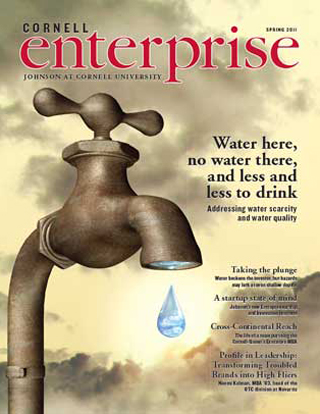
Taking the Plunge
Water beckons the investor, but hazards may lurk at even shallow depths
Illustration by Michael Austin
But experts in the economics of water warn that making money from it is neither simple nor easy. The public’s expectations about water’s abundance and price dramatically affect opportunities for investment.
“One of the biggest challenges about investing in the water sector is that, despite all the speculation on scarcity, water remains a cheap commodity across the United States,” said Zack Schildhorn, MBA ’08, an associate with Lux Capital Management investment firm.
Lakshmi Bhojraj, director of Johnson’s Parker Center for Investment Research, said, “Clearly there is a water shortage and it’s going to get worse worldwide. But because it’s a regulated industry, the public has been conditioned to expect cheap water.”
The investment possibilities in water are many and varied. They include big construction firms that provide traditional infrastructure of plants, pumps, and pipelines. Technology-based companies, including many startups and smaller firms, also are part of the sector. These firms often deal with water recovery, demand management, and treatment.
Some investment experts maintain that water can indeed be a smart investment. They point out that companies that use technology effectively and know how to operate in a public-private environment are poised to reap big rewards.
“The water problems of industries and communities are quite complex, and people will pay you a lot of money to solve complex problems,” said Amol Deshpande, MBA ’05, and a partner in the investment firm Kleiner Perkins Caulfield Byer. “The high-level view that water is cheap is not reason enough to neglect the sector. It’s too big and too important.”
Deshpande, who has been with Kleiner Perkins for three years, has been involved with several major investments in technology-based water companies. Firms devising ways to treat damaged water supplies represent an important opportunity, according to Deshpande.
He notes that concern is growing over micropollutants, such as chromium 6, a chemical found in water in Hinkley, Calif., and the subject of a much-publicized campaign by activist Erin Brockovich. Research is discovering other substances in water supplies with the potential to disrupt human endocrine systems.
“All of that body of knowledge of what is in our water is creating a world of opportunity for technologies that can deal with these contaminants and improve the safety of our water,” Deshpande said.
One such company is APTwater, Inc., based in Long Beach, Calif. Founded in 2009, the company has developed treatment technologies that can make wastewater and other polluted water drinkable. Company president and CEO, David Stanton, who received a bachelor’s degree in electrical engineering from Cornell in 1987, said the company is doing business with companies and governments around the world.
“If you have a good idea and a good solution and a good business plan, you can go make money in water,” Stanton said. “We’re growing, and we’re pricing well, and getting traction in the markets.”
Another new water company is NanOasis Technologies, Inc.,
co-founded by Chris Kennedy, MBA ’06 (E). NanOasis develops membranes used in desalination and other water treatment.
The membranes developed by NanOasis reduce the amount of energy used in water treatment. “What is poorly understood by many people is the interrelationship between energy and water,” Kennedy said.
Aaron Groom, MBA ’11, analyzes water and other utility investments for the Cayuga MBA Fund, Johnson’s student-managed hedge fund. He is cautious about investing in water: “In the domain of public markets investing, there are few pure-play securities that allow an investor to play the water scarcity problem, and most of them are already priced too richly to provide adequate returns.”


Post a new comment: