SPRING 2012
  • Features
  • |
  • Web Extras
  • |
  • Inside Johnson
  • |
  • Departments


  Bookmark and Share

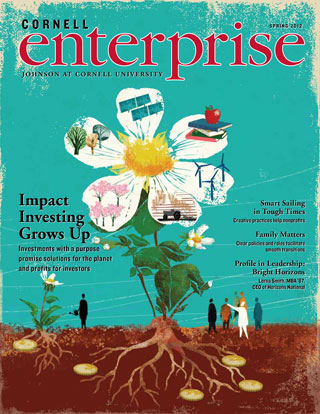
Smart Sailing in Tough Times

Creative practices help nonprofits steer through a perilous economy.


by Merrill Douglas
Illustration by Michael Austin
Just as it has for businesses and governments, the global financial crisis that started in 2008 has triggered tough times for nonprofit organizations. From 2007 through 2011, for instance, the 400 largest U.S. charities saw donations fall by a collective $6 billion, according to the Chronicle of Philanthropy.
Robert Ramin, MBA ’85, executive director of the National Aquarium in Washington, D.C., with General George, a stars and stripes pufferfish, also known as a white spotted pufferfish.


Oleander, the albino alligator that took up temporary residence at the National Aquarium in October 2011, became the focus of an ad campaign, and generated free media buzz


In the months following the Lehman Brothers bankruptcy in September 2008, even the most credit-worthy Latin American and Caribbean nations had trouble borrowing money to finance development projects. But the Inter-American Development Bank (IDB) remained a steady source of credit for its member countries in the region.

“We were actually able to increase our lending in 2008 and 2009 compared with previous years,” says Ed Bartholomew ’80, MBA ’82, the IDB’s chief financial officer and manager of its finance department.

A multilateral development bank based in Washington, D.C., the IDB makes loans to national, provincial, state and municipal governments, and to nonprofits and private sector companies. These loans support projects designed to eliminate poverty and inequality, and to encourage sustainable development. The IDB is owned by 48 member countries, including 26 borrowing countries and 22 that do not borrow.

To support its loans, the IDB has about $21 billion in equity, including both capital paid in by member countries and earnings accumulated over its 50 years of operations. It also borrows money in the international bond markets — $10 billion to $15 billion in a typical year — allowing it to support more than $66 billion in outstanding loans to the region at the end of 2011.

Because its financial policies are extremely conservative, the IDB maintained good access to credit markets even during the worst of the financial crisis, Bartholomew says. Still, demand for lending in the region that the IDB serves has increased in recent years. To meet this greater demand, in 2010 the IDB’s Board of Governors agreed to increase the bank’s ordinary capital by $70 billion.

This means the 48 member companies have agreed to subscribe to new shares in the bank. Each country will contribute some new money, but much of the commitment comes in the form of “callable capital” — money that the countries stand ready to provide in the future should the bank need it, and against which the IDB can borrow. As a result of the general capital increase, the IDB can sustain loan approvals to the region of about $12 billion per year, versus $6 billion to 8 billion per year before.

This sort of general capital increase is a used by many multilateral development banks. It’s the ninth such increase in the IDB’s history.

At a time when many economies are struggling, of course, making this further commitment to the bank is not an easy decision. “The general capital increase discussions are always time consuming,” Bartholomew says. The fact that the bank has never in the past actually called in the pledged capital probably makes the decision easier, he says. “They each have to evaluate whether they’re able to make that commitment. And in our case, they have.”

Recent news indicates that prospects are growing brighter. A 2011 survey by Giving USA, for example, noted that charitable donations rose by 2.1 percent in 2010. And in January 2012 the Wall Street Journal found at least a few large charities toasting the results of record-breaking fundraising drives.

But a surge in gifts in some quarters doesn’t mean it’s time for nonprofits to relax. As federal, state and local governments struggle with alarming deficits, many organizations that rely on public funds have seen that revenue stream taper off. Organizations with endowments still must keep a sharp eye on their investments. And as unemployment remains high, nonprofits of all types — from domestic violence shelters to historical societies to symphony orchestras — must work harder for donations, memberships and ticket sales.

On top of that, nonprofits in the human services field face a double bind. Just as the weak economy has forced many food pantries, job training centers, low-cost clinics and others to trim their budgets, they’ve seen demand for their services soar. “These are organizations that are already pretty lean,” observes Ingrid McKenney, MBA ’01, a fundraising consultant based in the San Francisco area. There’s little left for them to cut except program staff or fundraising staff — and neither choice bodes well for the agency’s mission.

For a nonprofit, surviving — or even thriving — in a rough economy takes focus, creativity, a sense of balance and a strong dose of courage.

Fishing for attention

Smart marketing, for instance, is always essential, but even more so when an organization must compete for scarce discretionary dollars.

Consider the cash a family might spend on getting close and personal with stingrays or sharks. “People cut back on things like attractions when money gets tight,” says Robert Ramin, MBA ’85, executive director of the National Aquarium in Washington, D.C. Founded by the U.S. government in 1932, the National Aquarium in Washington became a private nonprofit in 1981. In 2003 it forged an affiliation with the National Aquarium in Baltimore. Today, while they maintain separate finances and governance structures, the two venues share a membership program and a number of back office services.

The aquarium in D.C. finds competition for visitors especially fierce because it charges admission, while many other attractions in that city, such as the Smithsonian museums, do not. As visitors started arriving with less money, the National Aquarium was forced to hone its sales pitch. “We focused more on how this is a great investment of your time and your hard-earned lesiure dollar.” Ramin said.

Share of mind

Like Ramin, Robert Schultz ’77, MBA ’78, contends that staying in front of the public is essential. As president of the Causeway Agency, a Westport, Conn. marketing firm that supports good causes, Schultz helps nonprofits and government agencies such as the American Kidney Foundation, the National Crime Prevention Council, the U.S. Fund for UNICEF and the U.S. Environmental Protection Agency get out their messages and promote their brands.

“Our clients realize that even in difficult times they need to maintain, or even try to enhance, their presence, their share-of-mind and their share-of-wallet,” Schultz says. The ultimate goal might be to get people to write checks, but it also might be to prompt other actions — perhaps to get medical exams, stop buying counterfeit merchandise or buy fuel-efficient cars.

Several strategies help Causeway develop effective campaigns even when clients have little to spend, Schultz says. When creating a TV spot, for example, the agency shops hard for a production firm that can support the creative vision on a tight budget.

Causeway also stretches marketing dollars by using social media and obtaining public service announcements (PSAs) — print, outdoor and broadcast ads for nonprofits and government agencies, with time and space donated by the media.

“For every dollar that a client spends with us distributing a PSA campaign, we can generate on average more than $55 in donated media,” Schultz says.

Just as the National Aquarium made itself shine in a crowded tourist market, Causeway has helped one recent client, ChildFund International of Richmond, Va., set itself apart from other charities that help impoverished children.

ChildFund used to employ the same approach as many other charities with similar missions — for example, using images of starving children with distended bellies. “In our opinion, the category had become a little clichéd in terms of imagery and messaging,” Schultz says. While one doesn’t want to minimize the struggles of these children, he says, such over-used images no longer provoked a response from the public.

To make ChildFund stand out, Causeway decided to highlight the organization’s use of innovative technologies to fight poverty. For example, ChildFund had installed solar lighting in a school in Kenya so students could study later into the evening. It also had introduced energy-efficient wood stoves that village youth in Uganda could build and sell, earning them money while reducing pollution. “The campaign has performed very well,” Schultz says. It’s captured lots of free broadcast time and billboard space, and the market seems pleased with the new message. “The client has gotten lots of positive feedback from their key constituents.”

Well-connected

Beyond getting out the word about their work, nonprofits that rely on donations must work hard to build strong, ongoing connections with their supporters, says Christy Louth, MBA ’10 (Cornell- Queens), executive director of the Clinton Giustra Sustainable Growth Initiative (CGSGI) in Vancouver.

“You have a younger generation that’s coming up that really wants to engage,” Louth says. Older donors these days also want more than a thank-you note and an annual report, she adds. They want opportunities to see their money at work.

A registered Canadian charity, CGSGI is an initiative of the William J. Clinton Foundation that works to decrease the wealth gap in the developing world, particularly in Colombia, Peru, Mexico and Haiti.

With anchoring commitments from Canadian philanthropist Frank Giustra and Mexican philanthropist Carlos Slim, CGSGI has weathered the economic downturn well, Louth says. But the organization also relies on other individual donors and corporate sponsors, and it strives to make those donors feel they have a stake in the charity’s activities.

For example, CGSGI welcomes major donors who join staff members on visits to project sites. “I think it’s very important for them to see where the money is going and to meet some of the beneficiaries,” Louth says.

Low-cost information technology will help CGSGI push this strategy even further in the future. Already, employees working in the field are using the Salesforce.com platform to upload data about their projects into the “cloud”, making it available to Louth in real time on her iPad. “At any point, I can drill down to ask, for example, ‘How many cataract surgeries have we done in Peru? What regions have we had campaigns in this week?” CGSGI can give that kind of access to donors as well.

“We even have cameras set up on one of our projects,” Louth says. With a $10 mobile app and a password, donors can watch individuals gain construction skills and prepare for certification on site at a low income housing project in Soacha, Colombia. Because these tools and others like them are don’t cost much, smaller charities might also use them to make supporters feel more deeply involved in their missions, Louth says.

Show us what works

Not all segments of the nonprofit world are scrambling for funds. Some organizations, including some focused on education, have actually seen more funding become available since the start of the recession, says Barbara Sullivan, MBA ’00, portfolio manager for education at Strategic Grant Partners (SGP) in Boston. But that money often comes with greater demands for accountability.

A collaboration of 15 family foundations in Massachusetts, SGP makes grants to organizations that help struggling individuals and families and also provides grantees with pro bono consulting services. The grantees that Sullivan works with range from individual schools to grassroots advocacy groups focused on urban education. The federal government in particular has offered more funding for education in recent years, Sullivan says. “But it’s very much targeted towards things that work, and the ability to scale them.” Due to the weak economy, she says, funders in general are putting more emphasis on programs that show measurable results.

“They want the highest ROI [return on investment],” Sullivan says. “If they’re spending their money philanthropically, a lot of funders want to feel that it’s highly leveraged and highly valued.” In response, nonprofits are striving to operate more efficiently and thinking hard about who stands to benefit most from their services. “If they do need to streamline, they’re making sure they’re still working with the highest-impact clients,” Sullivan says. With more money available for education, Sullivan has been helping organizations in her portfolio pursue grants more aggressively, but only when those grants are a good fit, she says. “Sometimes the energy it would take to get the grant would be too much,” she says. And an inappropriate grant might distract an organization from its core mission. “They’re trying to make a grant fit because they want the money, but it shifts their work in a way that might not make sense.”

For nonprofits in general, one key to thriving in a tough economy is to maintain a diversified funding base, Sullivan says. “The organizations that I’ve seen weather this most successfully have a nice balance of small individual givers — because those folks tend to give year after year — some foundation grants and some government money.”

Earned Income

Along with aiming for a broad base of donors, some nonprofits are trying to develop an entirely different kind of revenue — the kind that’s earned, says McKenney.

Of course, many organizations raise income by selling T-shirts and other merchandise. But these aren’t necessarily the most effective efforts, McKenney says. “They don’t build community relationships in a meaningful way.”

A better strategy, she says, is to conduct a venture tied to the organization’s mission. Some animal welfare organizations, for instance, operate veterinary clinics.

While efforts of this sort can help, an organization must make sure that its supporters understand how earned revenue fits into the bigger fundraising picture. “Earned revenue can suggest that the organization might not need individual gifts as much,” McKenney says. “The perception has to be managed.”

For another example of a smart attempt to add earned revenue to the mix, McKenney points to one of her clients, the YWCA of Salt Lake City. Leaders there are thinking about marketing an educational program developed in-house to a wider audience.

First created to teach incarcerated women to build and maintain healthy relationships, the program might also be useful, for example, to corporations that want to offer it as a benefit to employees.

“It’s so tied to their mission that it makes a lot of sense,” McKenney says. And it might help the YWCA forge relationships that will pay off in other ways in the future.

Relationships can help nonprofits not only to bring in money, but also to cut costs. Nonprofits sometimes collaborate with like-minded organizations on programs or fundraising, of course. But unfortunately, McKenney says, few of them seize the chance to share services — for example, by using one office to manage data processing or human resources for several organizations.

“Some of that comes from ego,” McKenney says. Organizations’ leaders can be so focused on saving the world in their own way that they’re reluctant to join forces. Leaders may also want to protect jobs — “which, fundamentally is not relevant,” she says. “If you want to carry out your mission as effectively as you can, you create efficiencies to achieve the best model.”

Kaizen in the Thrift Shop

Of course, organizations also look inward for ways to cut costs. Toward that end, Kenneth Colling, MBA ’69, president and CEO of Seattle Goodwill, has been using process improvement strategies borrowed from for-profit industry. “We’re basically applying good business school practices in the nonprofit world,” he says.

Seattle Goodwill, an independent organization affiliated with Goodwill Industries International, offers a broad array of programs that help economically disadvantaged people develop job skills and find employment. It serves a five-county region in northwestern Washington.

More than 90 percent of Seattle Goodwill’s revenues come from donated items, which the organization sells in its 21 thrift stores and two outlet stores, as well as on line and through the global salvage market.

For a charity such as Seattle Goodwill, the recession is a doubleedged sword, Colling says. On one hand, more people are shopping in thrift stores. “And we’re still receiving a good stream of quality donations.” But if the economy stays sluggish for too long, the number and quality of items that people donate could drop.

Demand for Goodwill’s services continues to grow. Traditionally, most of its clients are people with no job experience, or people who have trouble finding work because they’re homeless or have served time in prison. “Now we’re also seeing more middle-aged or older people who have been laid off after working for the same company for many years,” Colling says.

To meet the new demand, Seattle Goodwill is adding both training centers and thrift stores. And even before the recession, it had started applying the principles of Total Quality Management to all sorts of functions — from registering students to routing the trailers that collect goods from donation centers to operating thrift stores.

For example, Seattle Goodwill has used kaizen — the principle of continuous improvement pioneered by Japanese automakers — to find more efficient ways to sort piles of donated items and apply price tags.

“There are a lot of steps in that process that you can eliminate,” Colling says. To identify those steps, teams of employees have met for formal kaizen events, in which they analyze the work to devise better methods. “Then you’ve got to keep measuring the gains and your improvements,” Colling says. “Otherwise, you can’t keep moving forward.”

If a weak economy forces more nonprofits to become more efficient and effective, ultimately the story of the recession will produce a happy ending.

“Nonprofits tend to be very opportunistic, especially in the early years,” says Sullivan. “But often that leads to some very diversified work that doesn’t always play to their core competencies. I think the tighter funding environment helps them focus on the things that make the greatest difference.” That’s true on the program side, and it’s also true for fundraising and operations at the most successful organizations. “We’re working harder and making our funding go farther, and that’s not going to stop,” Ramin says. “That to me is a real silver lining.”

Freelance writer Merrill Douglas regularly covers issues affecting nonprofits and corporations.

  • Features
  • |
  • Web Extras
  • |
  • Inside Johnson
  • |
  • Departments


Rss feedSubscribe to the comments for this page

Comments (0)

Post a new comment:

Name:

Email:

Comment:


  • Johnson Home
  • |
  • Alumni Home
  • |
  • About Enterprise Online
  • |
  • Contact
© 2013 Samuel Curtis Johnson Graduate School of Management